



Why Content Ranks but Doesn’t Get Picked (And How to Fix It)


You can do everything right and still miss.
The page is optimized. It follows the brief. It covers the topic. It might even rank. But it doesn’t show up where it matters, not in AI answers, not when someone is actually deciding.
That’s when teams start second-guessing everything.
Was the keyword wrong? Is the competition just better? Do we need to rewrite the entire page?
Most of the time, none of those are the real issue.
The harder problem is that content doesn’t usually fail in obvious ways. It fails in smaller ways that add up.
A section doesn’t go deep enough. A key idea is implied instead of explained. Another site answers the question more directly, or more completely.
Those differences don’t look like much on their own.
But they add up.
Why content ranks but still doesn’t get picked
Most content isn’t wildly off. It’s off in smaller ways that are harder to spot.
That’s what makes this frustrating. Nothing looks broken, but performance stalls.
Search visibility now depends on completeness.
If your content doesn’t fully match what the query requires, it’s easier for platforms to skip it.
What Content Similarity actually is
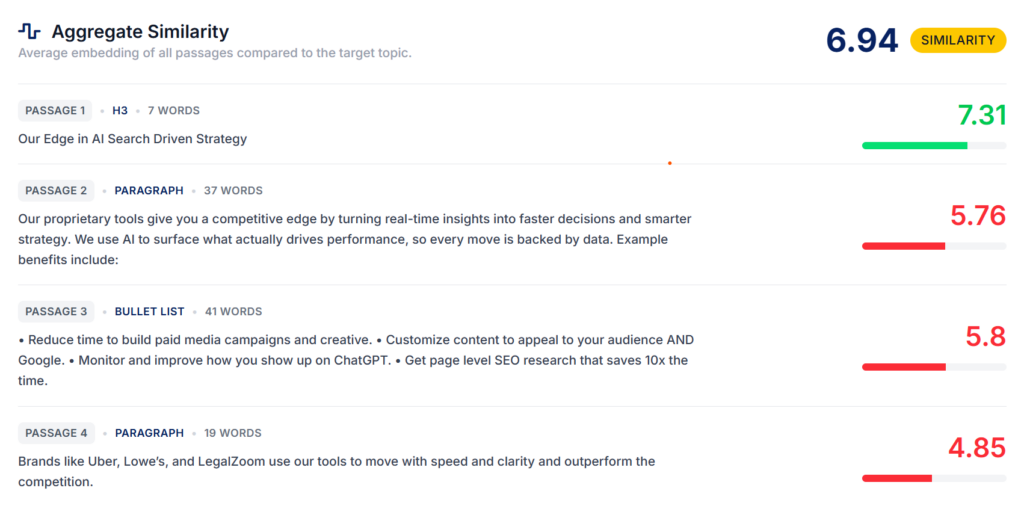
Content Similarity is a content optimization approach that evaluates how well each section of a page aligns with search intent, semantic relevance, and competitor coverage.
It looks at your content the way search engines and AI systems do, not as a single page, but as a set of sections that either meet the query or fall short.
Why this matters now, and what it looks like in practice
Search is no longer just about ranking.
It’s about selection.
That shift is subtle, but it changes how content actually performs.
Your page isn’t just competing to appear on a results page. It’s competing to be pulled into an answer, summarized in an AI Overview, or used as a source when someone is trying to make a decision.
And that bar is higher.
If your content only partially answers the question, or leaves gaps that another page fills more clearly, it’s easier for platforms to skip it entirely. That’s why pages can rank and still underperform. They’re visible, but they’re not being used.
This is where most teams get stuck.
Because nothing looks obviously broken. The page exists. It’s optimized. It’s doing something. But it’s not doing enough to be selected.
And that’s where the difference shows up.
In practice, improving performance usually doesn’t mean starting over. It means tightening what’s already there.
Expanding sections that don’t go deep enough. Clarifying ideas that are implied but not clearly explained. Making sure the page fully matches how the query is actually being answered across competing results.
You can see how that plays out at scale in our MoneyGeek case study.
The gains didn’t come from rewriting everything. They came from improving alignment across thousands of pages, fixing the parts that weren’t doing enough, and making sure each page actually matched what the query required. That’s what led to a 75% increase in clicks and more than 26 million impressions.
You see the same pattern in B2B.
In our Bandwidth case study, stronger alignment on high-intent pages didn’t just improve rankings. It improved the quality of traffic and had a direct impact on pipeline. The pages were already close. They just weren’t complete enough to get picked consistently.
That’s really the shift.
Once you can see where content falls short, the workflow changes.
You stop thinking in terms of rewriting pages or running broad audits. You start thinking in terms of improving specific sections that are holding performance back.
And that’s where this connects to a broader system.
Content Similarity doesn’t work in isolation. It ties into how content gets planned, improved, and measured over time.
- Outlines helps ensure the structure is right from the beginning
- Page Optimization shows what to prioritize once something is live
- Page Monitoring helps you understand what changed and how it impacted performance
You can see how those pieces connect across the Barracuda Modules.
That’s what makes this repeatable.
You’re not guessing anymore. You’re working within a system that shows you where to look and what to fix.
And you don’t need to apply that everywhere at once.
Start with one page.
Pick something that feels close, not broken, just underperforming.
Look at where it falls short. Fix a few sections.
That’s usually enough to show you what to do next.
Key takeaways
- Content can rank and still get skipped if it doesn’t fully match intent. Visibility now depends on whether your content can be used, not just whether it appears.
- Most performance issues come from small gaps, not full-page problems. A few weak sections can hold back an otherwise strong page.
- Fixing specific sections is usually more effective than rewriting everything. Small, targeted updates tend to drive faster results.
Frequently asked questions about content similarity in SEO
Why does content rank but not show in AI answers?
Ranking signals relevance, not completeness. AI systems prioritize content that clearly and fully answers a question.
What is content similarity in SEO?
It’s how closely your content aligns with search intent and top-performing results. The focus is on depth and coverage, not duplication.
Do I need to rewrite entire pages to improve performance?
Usually no. Most pages only need a few sections improved to perform better.
Does content similarity affect SEO rankings?
Yes. Better alignment improves how content is evaluated and increases visibility in both rankings and AI results.
How do I know where my content is falling short?
Compare your page to what’s currently ranking. The gaps in depth and clarity are usually easy to spot.
See What’s Holding Your Content Back
Most content problems aren’t obvious. A page can rank, drive traffic, and still underperform where it matters most.
Barracuda helps teams identify where content falls short before performance drops further, whether that’s in AI visibility, organic search, or conversion-focused pages.
